The Painting That Seemed to Find Its Own Meaning
The story behind Filleadh Ar do Dhúchas, one of my favourite paintings from Éire Mo Chroí.
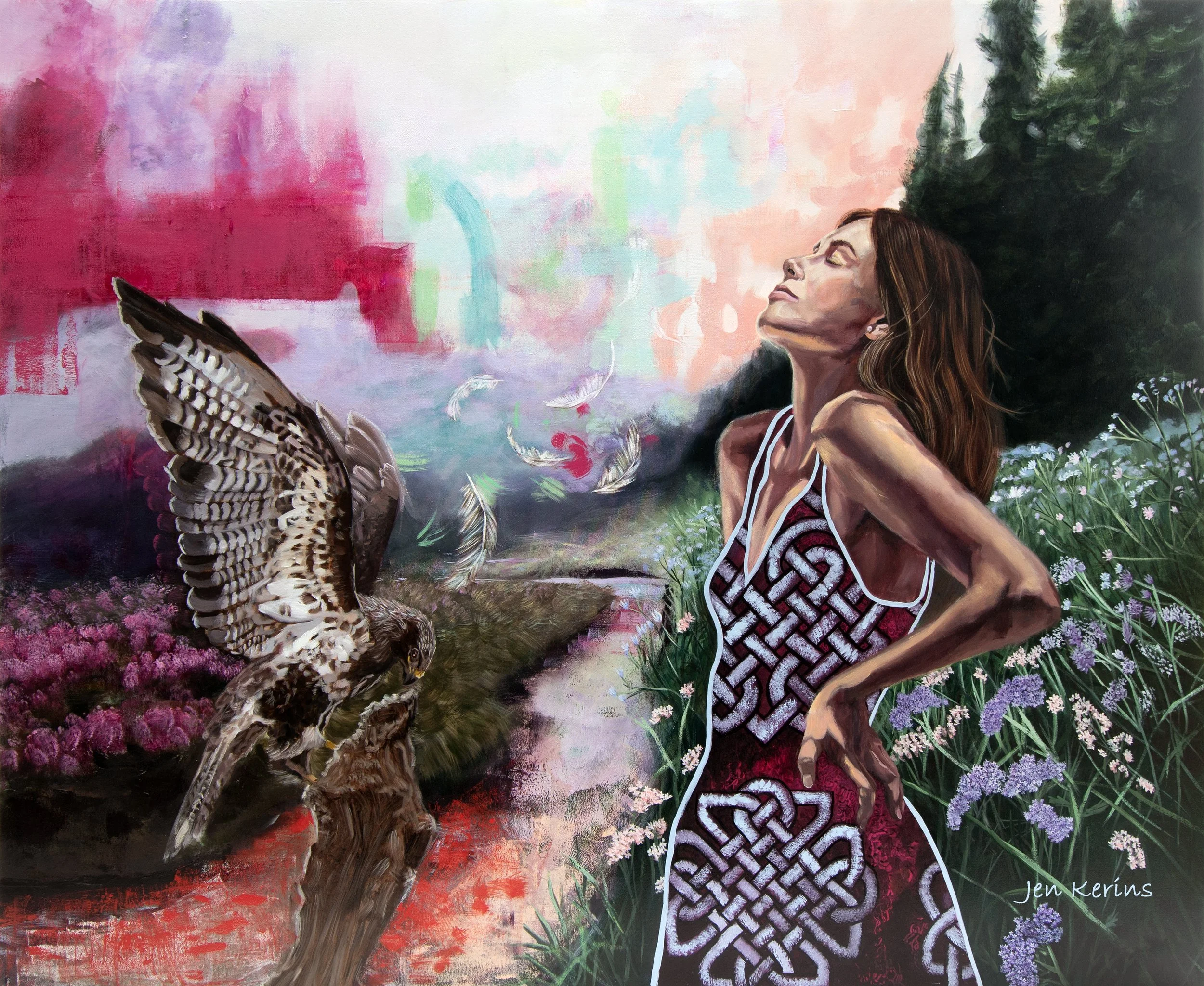
I had already named the painting Filleadh Ar do Dhúchas, meaning “return to your roots,” when I discovered that the buzzard at its centre had its own story of return.
Buzzards had become extinct in Ireland by the end of the nineteenth century, but eventually recolonised the island naturally. Without knowing that, I had placed one beside a woman reconnecting with her Irish heritage and given the painting a title about finding your way back to where you belong.
It was one of several meanings that revealed themselves only after I had begun painting. A river emerged through abstract marks in the centre. Members of my family recognised in it a place I had not consciously painted. Colours and symbols began to connect with memories I had not originally set out to depict.
Of all the paintings I created for Éire Mo Chroí, this may be my favourite. Partly, that is because of what it means to me. But it is also one of those rare paintings that seemed to know what it wanted to become.
Finding the story in the painting
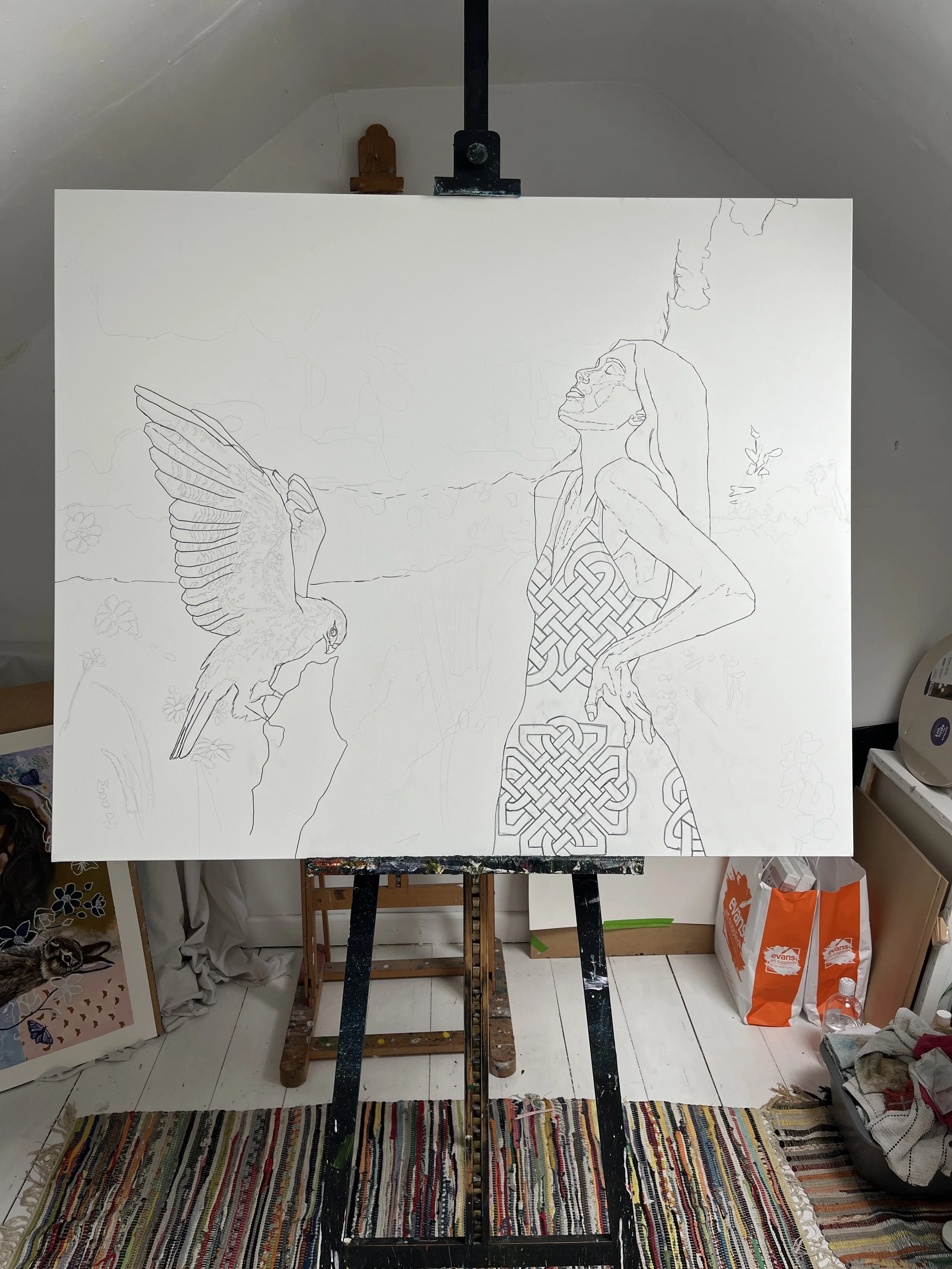
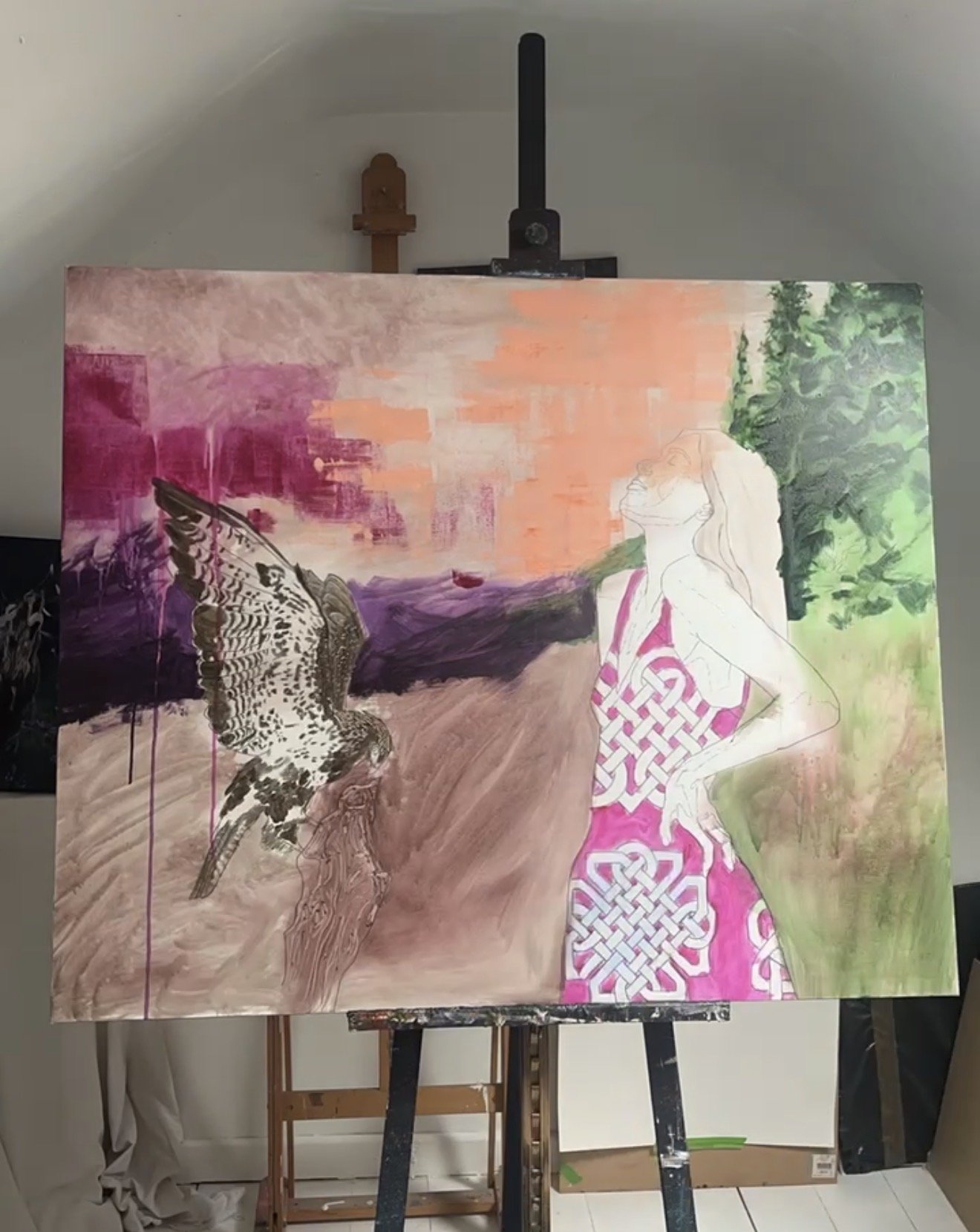
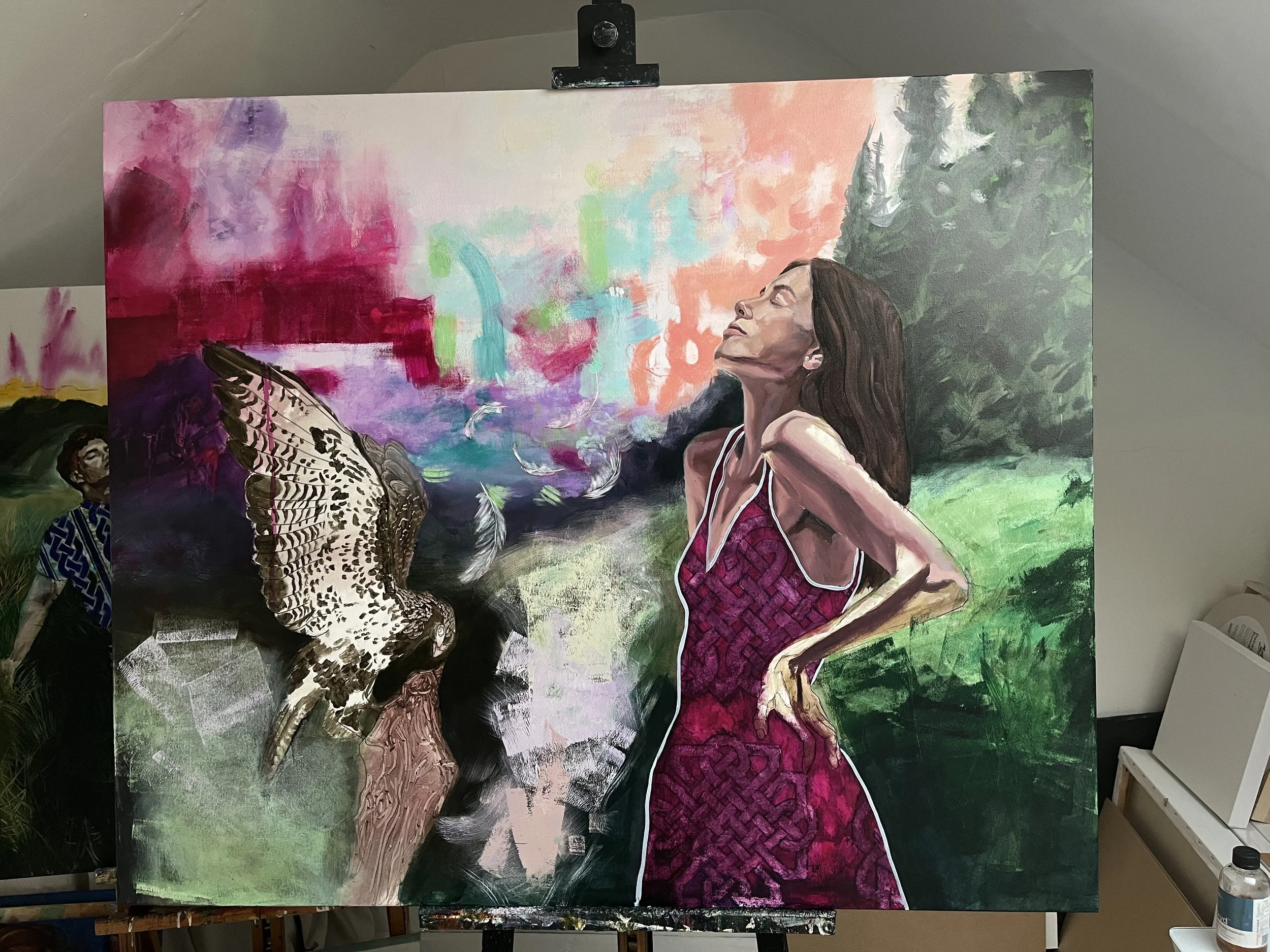
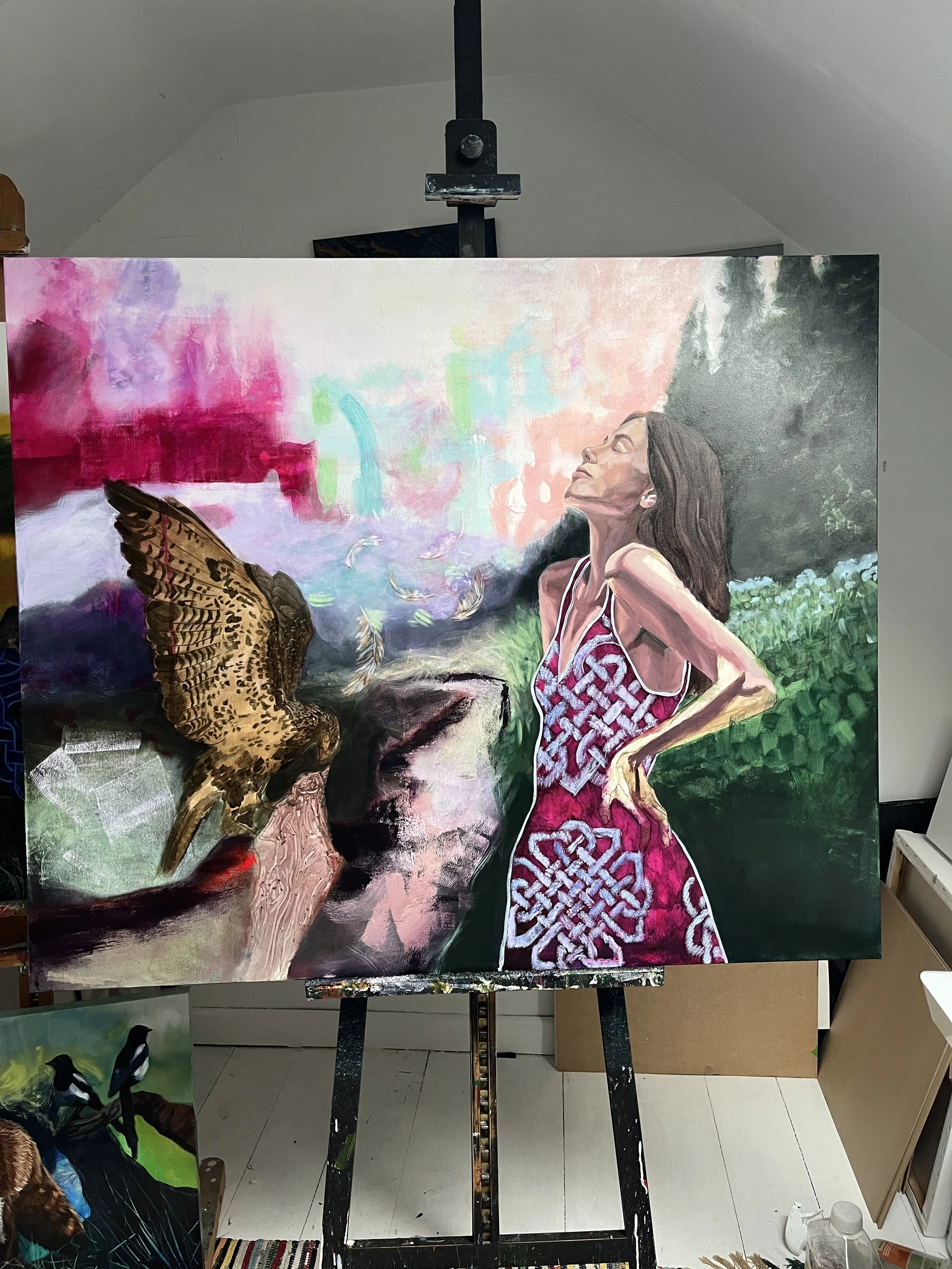
Like most of the works in Éire Mo Chroí, it began as a digital source image. Using Pixelmator, I combined a figure with an animal found in Ireland, experimented with an abstract background, and layered photographs I had taken in different parts of the country until I found a composition that felt right.
I do not usually begin these images with a completely formed message. That part comes afterwards. Once the composition exists, I start asking what it is expressing to me: what I might be trying to tell myself through it, or what I need to remember.
With this one, I immediately understood the feeling I wanted to capture: the sense of peace and belonging that comes when I stop moving through a landscape and allow myself to be fully present in it.
As I began painting, I saw what looked like a river emerging through the marks in the middle of the composition, so I decided to lean into it. My dad and my brother Paul both thought it looked like a river at Lough Dan, a place we often hiked as a family. I had not used any photographs from there when constructing the image, but once they pointed out the resemblance, I could see it too.
On a recent hike there, we had come across an old ruin, where a powerful wind seemed to appear from nowhere. My parents spoke about it as a sign that the Good People, or perhaps our ancestors, were present.
That memory stayed with me. It led me towards the title Filleadh Ar do Dhúchas: return to your roots.
At the time, I was reading Manchán Magan’s Thirty-Two Words for Field and Listen to the Land Speak. I had become fascinated by the idea that knowledge can be held not only in books, but within language and the land itself.
The painting began to feel like a reminder that our ancestors are not entirely separate from the landscape they lived upon. Their presence remains in the land, in the stories attached to it and in the language once used to describe it. When we spend time in nature, perhaps we come a little closer to them, and to parts of ourselves that modern life can make easy to forget.
Remembering who she is
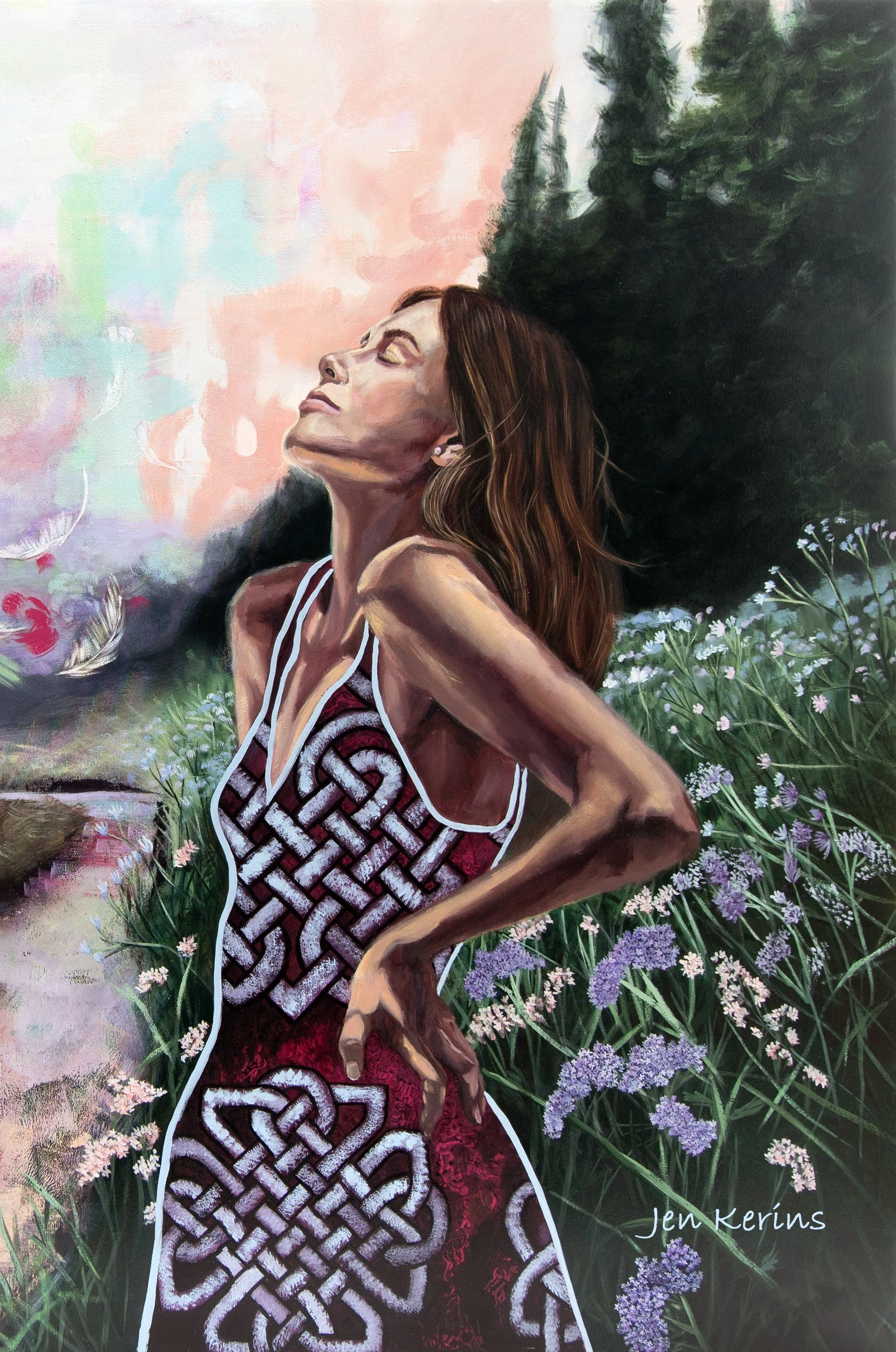
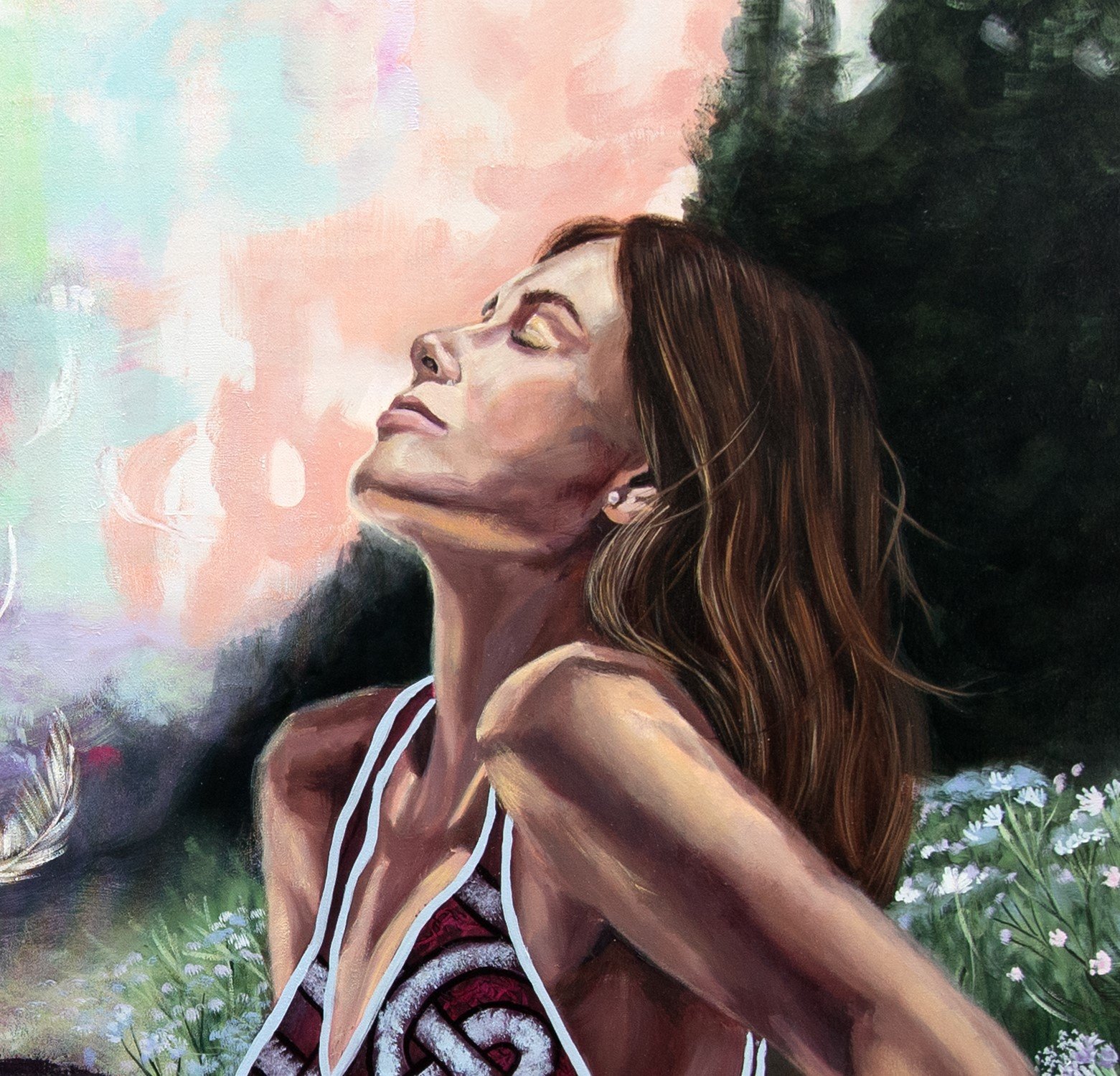
The woman in the painting is not intended to be any particular person, but what she came to represent developed as I built the composition around her.
She stands with her hands on her hips, opening her chest as she takes a deep breath. Her head is tilted towards the sky and her eyes are closed. I imagine her feeling the warmth of the sun on her face at the same time as the cool breeze moves around her, listening to the water and the sounds of the landscape.
She is not simply standing in nature. She is allowing herself to become part of it.
The luminous Celtic pattern forming what appears to be her dress is important to that idea. It was never intended to be a pattern printed on ordinary clothing, although I understand why it may initially appear that way. I deliberately avoided painting the folds, shadows and weight that real fabric would have.
Instead, the pattern exists in place of her clothing. It is something luminous emerging from within her rather than something she has chosen to put on. To me, it represents a sense of Irish and Celtic belonging that already exists inside us, waiting for our permission to come forward when we are ready to reconnect with it.
The buzzard’s meaning revealed itself in a similar way.
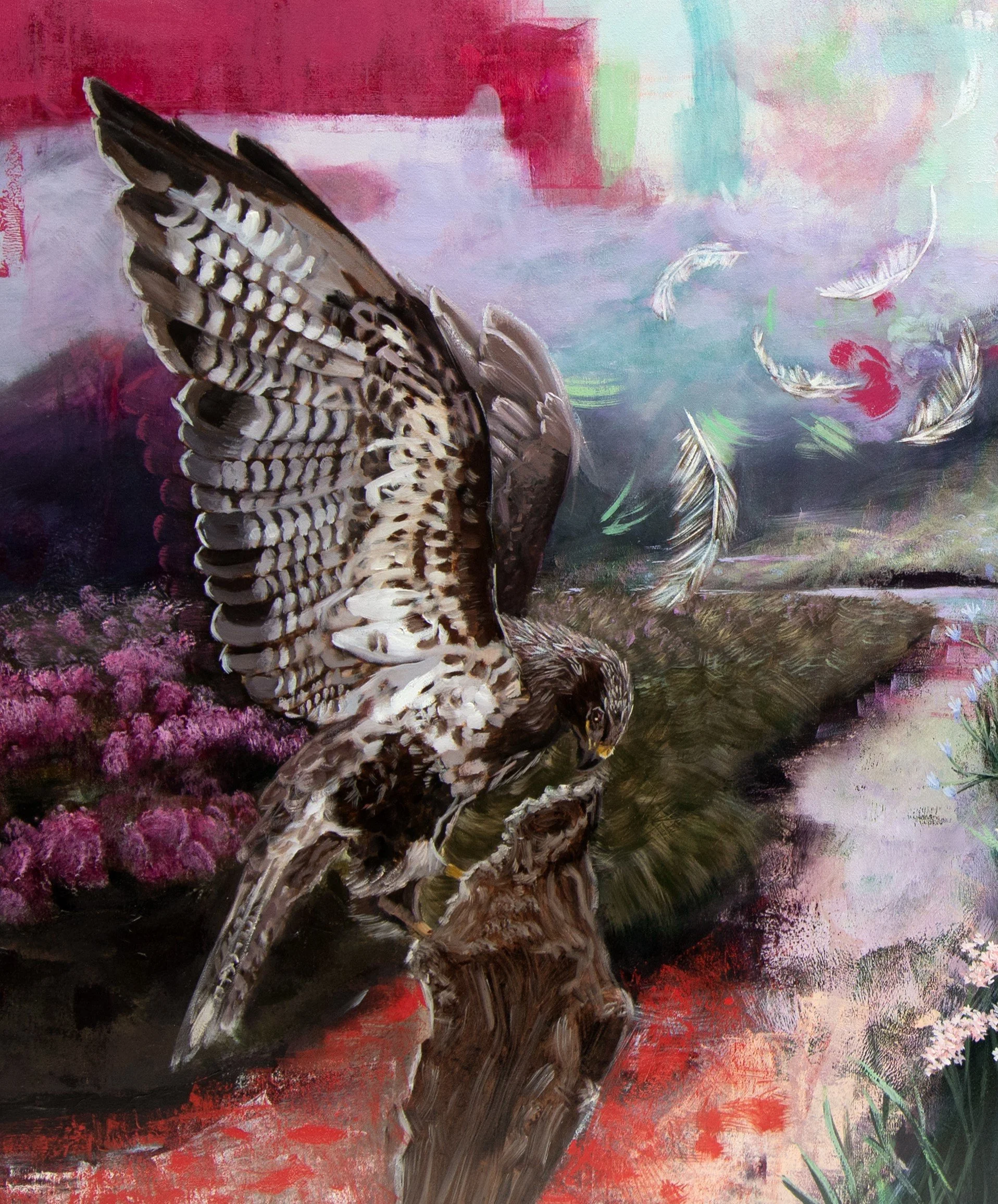
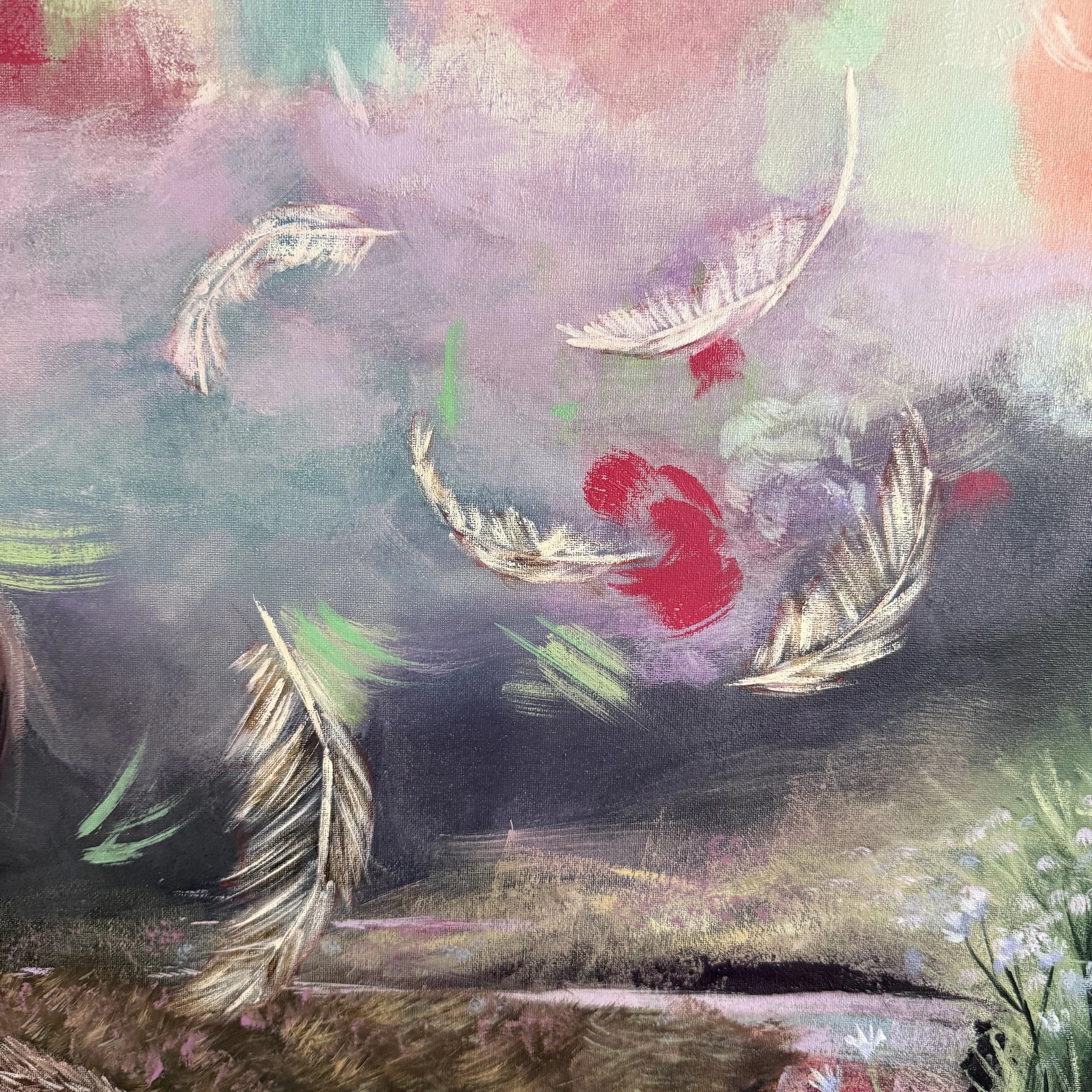
I had begun noticing buzzards around Ireland and had become fascinated by them. Until then, I had not realised that we had such large birds of prey living there. When creating the composition, I was particularly drawn to the posture of this one. The shape of its wings seemed to mirror the woman’s open chest and arms braced at her hips, creating an unspoken connection between them.
Because I have always been interested in animal symbolism, I eventually began researching the buzzard. That was when I learned that buzzards had become extinct in Ireland by the end of the nineteenth century before later recolonising the island naturally.
I had already chosen the title Filleadh Ar do Dhúchas before discovering this. Learning it felt like another part of the painting clicking into place.
The buzzard became a natural symbol for something once lost finding its way home again. It also reflected my hope for the Irish language: that something pushed almost to the point of disappearance could return and establish itself again.
The feathers moving between the bird and the woman strengthen that connection. I originally painted them as though they had fallen from the buzzard and were being carried towards her by the breeze. But feathers also held associations for me with ancestors, the Otherworld and a connection between what can and cannot be seen.
I imagine an exchange of energy taking place between the woman and the bird. Perhaps it is an ordinary buzzard, or perhaps, within the world of the painting, it is in an Ancestor, or one the Tuatha Dé Danann, appearing in another form.
Either way, the woman is remembering who she is. She is reconnecting with the people who came before her, the history of the land, her own strength and a part of her heritage that had always been waiting within her.
She is not being given a new identity. She is recognising what was already there.
When a painting almost makes itself
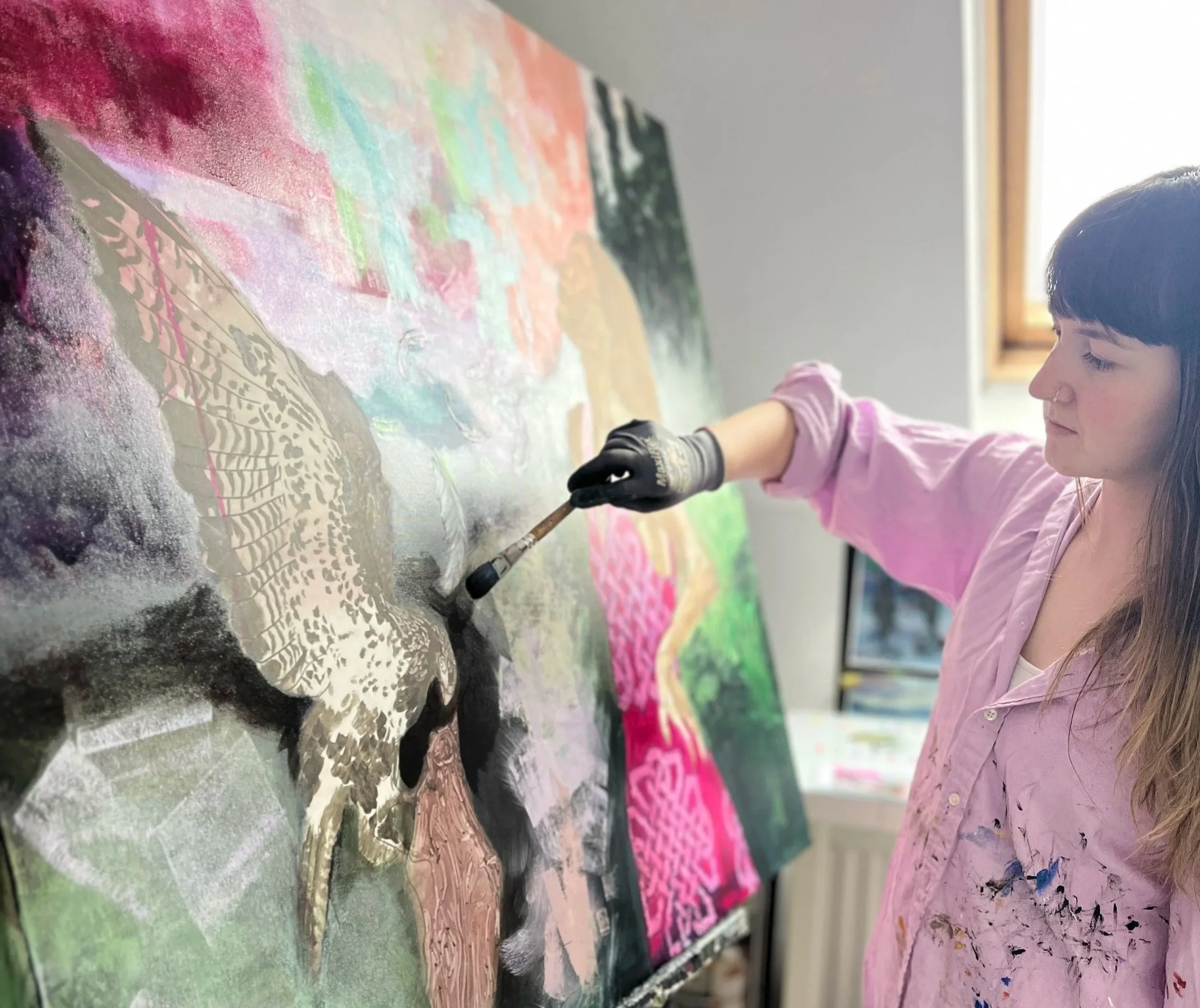
At 120 × 100 centimetres, Filleadh Ar do Dhúchas became one of the largest paintings in the collection. I had not initially planned to make this particular image at that scale, but as soon as the source composition was complete, I knew it needed the space.
I drew the woman and buzzard first, then built an acrylic underpainting using washes, rollers and brushes before moving into oils. The figure, bird and much of the landscape became highly rendered, while the sky, river and heather remained looser and more abstract.
Some paintings resist you at every stage. This one did not. Even when it passed through the inevitable ugly stage, I could still see the way forward. The river emerged almost by accident and the sky developed through experimentation, but instead of forcing them back towards my original source, I followed what the painting seemed to be offering me.
When it was finished, I remember thinking that whoever eventually lived with it would be incredibly lucky. More honestly, I wanted it on my own wall.
At the Éire Mo Chroí exhibition, it was positioned so that visitors first encountered it from a distance, before moving closer to discover the feathers, Celtic pattern and smaller details. It became one of the works people mentioned most often.
A piece of home
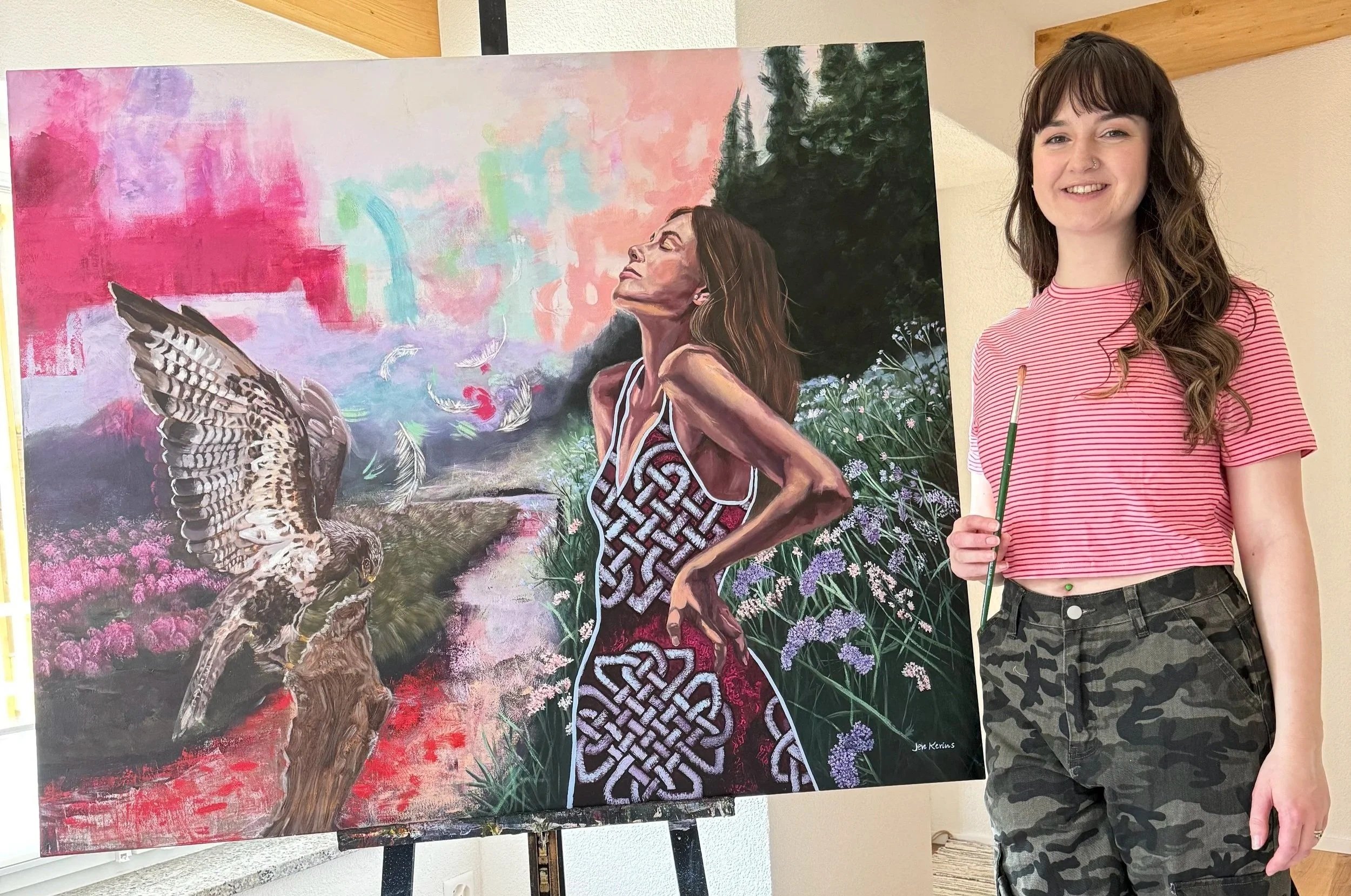
When I painted Filleadh Ar do Dhúchas, I was still living in Ireland. I now live in Switzerland, and I am very glad that this was one of the paintings I was able to bring with me.
Its meaning has not necessarily become more intense since I left, but its physical presence has changed. It is now a piece of home I can carry with me. It reminds me of how much I love my country, even if Ireland is not the right place for me to live at this point in my life.
There is, for me, a particular feeling within the Irish landscape that I have experienced in very few other places. I feel it most strongly on the west coast. Ireland is not the only beautiful country I have visited, and Switzerland is spectacular in an entirely different way, but beauty is not quite the same thing as that sense of presence.
The more I have read about Ireland’s older beliefs, and the more attention I have paid while spending time in the landscape, the more seriously I have come to believe in the Good People, the fairy folk I understand as the Tuatha Dé Danann. To me, they belong to an older way of understanding the world in which the sacred is not somewhere distant from us, but present within the land itself.
The woman was never meant to be me, but she represented something I was experiencing while I painted her: a rediscovery of my culture, the landscape and the beliefs that had existed there long before me. Now she serves as a reminder.
Most of all, the painting comforts me. Sometimes when I look at her, I find myself copying her posture. I put my hands on my hips, open my chest, tilt my face upwards and close my eyes. For a moment, I can imagine myself back in Ireland. I can almost feel the breeze and hear the landscape around me.
There are certainly many references to Ireland in the piece, and perhaps its full story carries more meaning for someone who shares that cultural connection. At the same time, I do not think you need to be Irish to experience something through this painting. Paintings never hold only the meaning their artist gives them. Their meaning changes depending on who is standing before them.
Beneath all its references to Ireland, Filleadh Ar do Dhúchas is about the feeling of belonging. It is about the moment when you stop experiencing nature as something outside yourself and remember that you are part of it. In that moment, you are exactly who you are supposed to be. You are enough. You are supported by something larger than yourself.
I will miss this painting when it finds its home, but knowing that it could give someone else the experience it has given me would outweigh that loss. Paintings are made to be shared.
Perhaps the best way to understand this one is not to interpret every symbol, but to stand as the woman does.
Lift your head. Open your chest. Close your eyes.
Take a deep breath, and remember that you belong here.
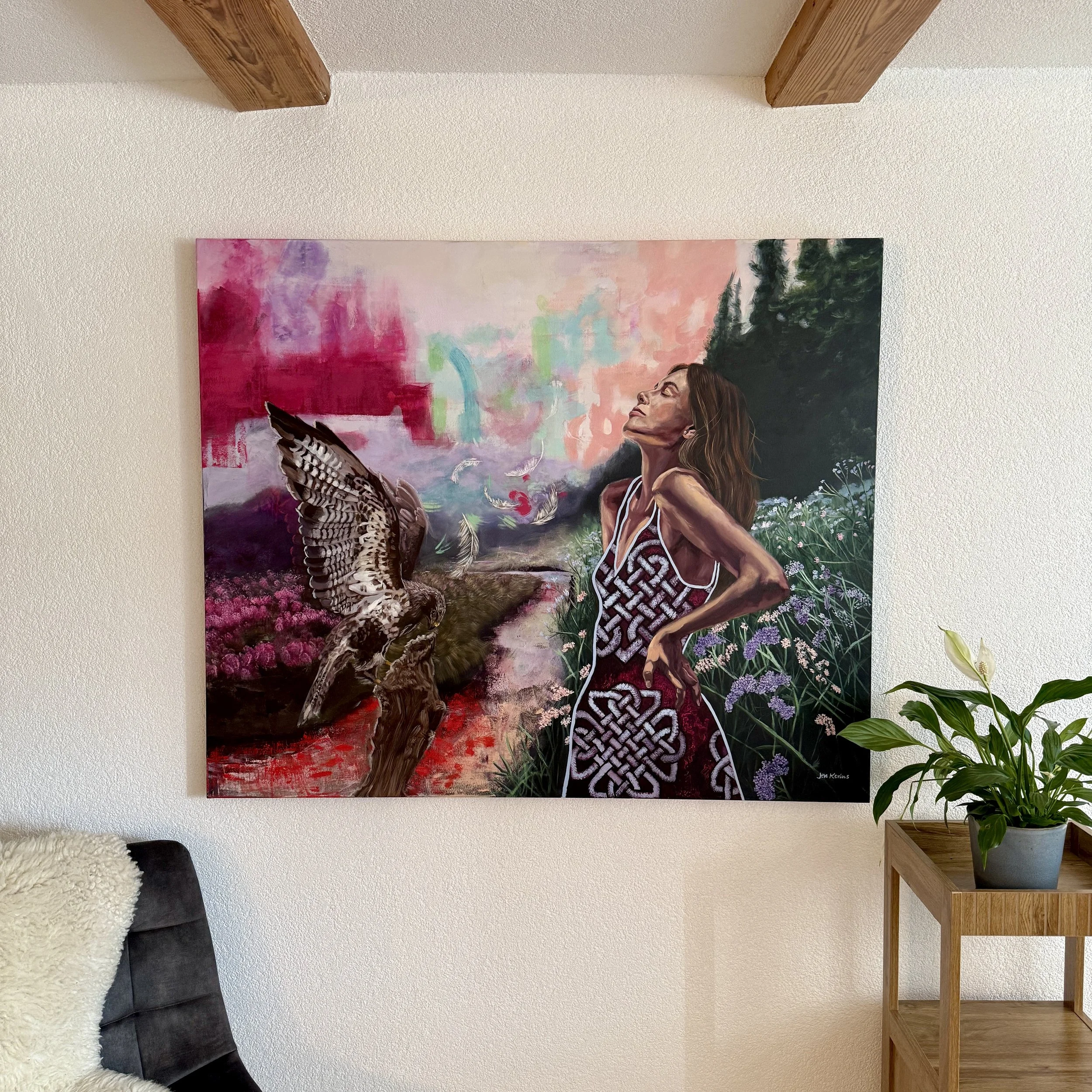
Filleadh Ar do Dhúchas is an original 120 × 100 cm oil painting on gallery-wrapped linen and is currently available. Fine-art prints will soon be available for those who would like to live with the image on a smaller scale.